Need a little more direction?
Watch our tutorial


20 hr 0 min
20 hr 0 min

0 from 0 reviews

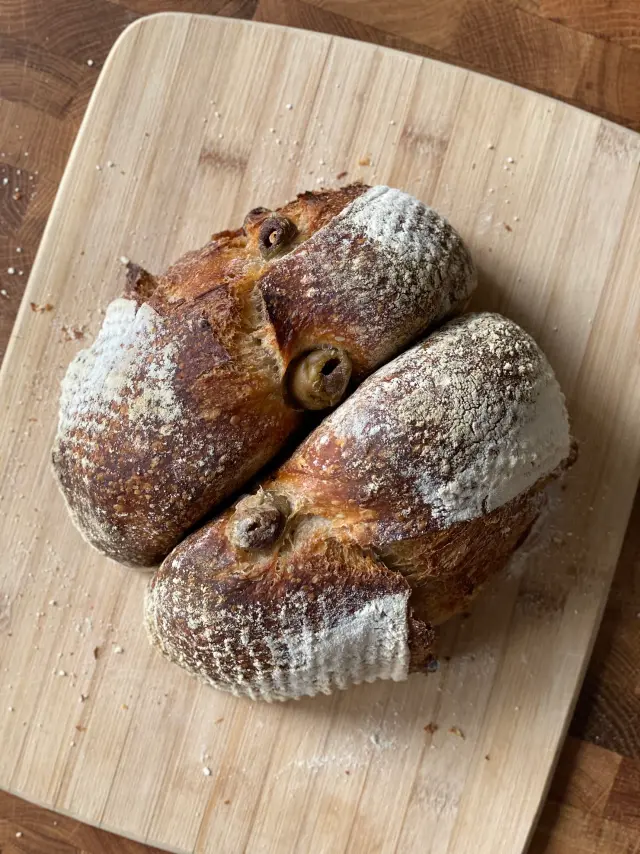
Bread and Olives. It’s one of the best couples. I don’t know what about you but as long as there are some olives in my bread I know it will be super yum. If someone asks me what add-in should she/he put in a sourdough loaf I would definitely recommend adding olives. Who doesn’t like olives?! My trick is to add the whole olives. I don’t cut them for few reasons. First because once you use whole instead of sliced, there are fewer olives pieces that will disturb the dough to develop and proof correctly (remember- every topping we add to our dough disturbs a bit for its development). The other reason is that it is amazing to slice your bread and get a huge chunk of olive in your bite. I promise you- once you try it, you’ll never go back. I used here two types of olives that I love- Nostralina olives, which are the Italian equivalent of Kalamata olives, and Manzanilla- originating from Sevilla, southern region of Andalusia, Spain. Obviously, you can use any kind of olives you like guys. Just keep them whole. And pitted.
Dutch oven
Bowl
Parchment paper
Towel
Scale
Bench knife
Scraper
Proofing basket

In a bowl mix the flour and water. Let it autolyze for an hour covered with a towel (in “autolyze” the flour absorbs the water, becoming fully hydrated. This will activate gluten development).
Add the starter and fold it into the dough. Rest for 30 min.
Add the salt and a sip of water. Mix until all incorporated into the dough. Rest for 30 min.
Perform two coiled folds. 30 min rest in between.
Now we will add the olives- spread a sip of water on the working surface, it helps prevent the dough from sticking to the surface.
Stretch the dough to a thin layer and spread the olives on top. Try to avoid adding their liquids as well. This step is known as lamination.
Fold the dough and place it back in the bowl.
Perform another 3 folds. 30 min rest in between.
After folding the dough another 3 times, let it rest for an hour before pre-shape.
Divide and pre-shape- round the dough to a beautiful tight ball. 15-20 min rest.
Shaping. Place in a proofing basket and let it rest in RT for an hour before you place it in the fridge to ferment overnight.
The next day, preheat your dutch oven to 470°F or 245°C for an hour.
Score the loaf directly from the fridge. Close the lid of the dutch oven and let it bake for 30 min.
Remove the lid and bake for another 20-30 min (depends on how you like your crust).
Let it cool on a rack for an hour before you slice it! Share it with your lovers, it’s too delicious to eat alone.
YASSS!
Watch our tutorial


write your comment